

AI agents resolving customer-service tickets for an Australian law firm
An Australian personal injury law firm introduced AI agents into its Zoho Desk service operation. The work covered appointment requests, document follow-ups and case-status enquiries, with human involvement wherever a request concerned legal advice.
Discuss your AI customer-service workflow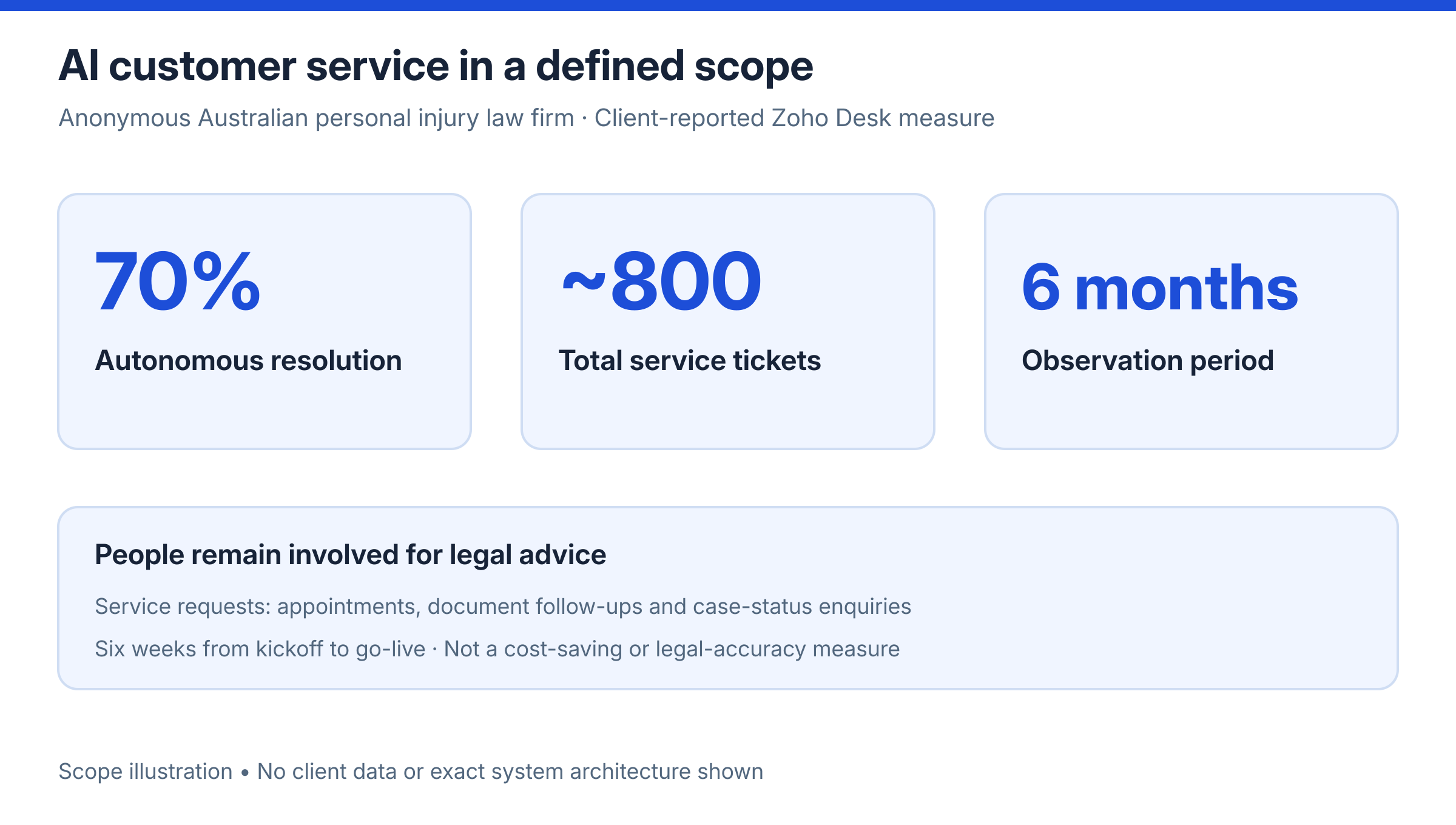
Service work inside the existing ticketing platform
The agents responded to customers and closed suitable service tickets autonomously. The implementation used the OpenAI API, Zia agents and custom scripts, alongside retrieval-augmented generation and Model Context Protocol. Zoho Desk remained the ticketing platform.
The project took six weeks from kickoff to going live. The firm’s identity remains confidential.
The result over six months
The firm reported 70% autonomous resolution across approximately 800 incoming customer-service tickets over six months, using Zoho Desk reporting. The 800 tickets represent the total observed volume for that period.
This is a measure of service tickets resolved without human involvement. It does not describe legal advice given by an AI system, legal matters decided, or a corresponding reduction in staffing costs. Enquiries involving legal advice kept a person in the loop.
What this means for another service team
The useful starting point is a repeatable service request with a clear answer source and an explicit boundary for human involvement. The project shows how agents can work within an established service platform, with performance measured against actual tickets.
Discuss a customer-service workflow. Tell us what reaches your service desk and which decisions must stay with people.
Frequently asked questions
What enquiries did the agents handle?
The agents handled customer-service enquiries such as appointment requests, document follow-ups and case-status questions. They responded to incoming tickets and closed suitable tickets autonomously. The scope concerned service around legal matters; it did not include independently giving legal advice or deciding the outcome of a client’s legal claim.
What does the 70% result mean?
The firm reported that 70% of approximately 800 incoming customer-service tickets were resolved without human involvement over six months. The measure came from its Zoho Desk reporting. It is an autonomous ticket-resolution rate, rather than a measure of legal accuracy, payroll reduction, customer satisfaction or the percentage of legal matters automated.
Was the volume 800 tickets each month?
No. Approximately 800 is the total number of incoming service tickets over the six-month measurement period. Keeping that period alongside the resolution rate makes the result easier to interpret. The case does not claim the same performance at a much larger volume or across every category of legal enquiry.
When did a person remain involved?
Enquiries involving legal advice kept a human agent in the loop. That boundary was part of the service scope. A different organisation would need to define its own escalation and approval rules around the decisions being made, rather than assuming every request can be handled autonomously because an agent is available.
What platforms supported the implementation?
The implementation used the OpenAI API, Zia agents and custom scripts, with retrieval-augmented generation and Model Context Protocol as part of the solution. Zoho Desk was the ticketing platform and the source of the reported measure. The case does not imply that using the same tools guarantees the same result elsewhere.
How long did implementation take?
The project took six weeks from kickoff to going live. The reported resolution measure then covered six months of service tickets. Those are different periods: one describes delivery and the other describes observation of the live service. Any new implementation needs its own schedule based on scope, access and acceptance requirements.
Does this demonstrate a 70% cost saving?
No. The result concerns tickets resolved without a person handling them, not a calculation of costs saved. A commercial evaluation would also consider implementation, licences, model usage, supervision and ongoing operation. This case reports the client’s service measure without turning it into a financial claim that was not established.
How should we choose our first service automation?
Start with a clearly defined enquiry type, an accountable service owner and a reliable source of information. Identify which decisions must remain with people and how success will be measured in your ticketing system. That creates a useful basis for assessing a project before attempting automation across the entire service operation.